NEWS
The industry has spoken: standards, not technology, are holding back low-carbon concrete

By Dr. Elizabeth Gilligan, CEO & Co-founder of Material Evolution
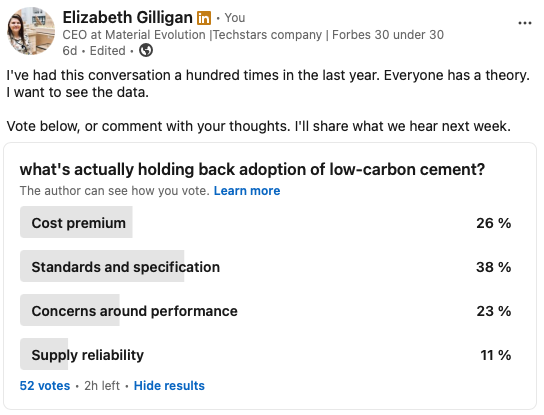
I ran a poll last week on LinkedIn to ask the industry what’s holding back adoption of low-carbon cement. With more than 50 industry responses, the results (above) tell an important story.
First, the results highlight something important about the cost conversation. While cost premium remains a concern, it ranked significantly lower than standards and specifications. That suggests the industry is not simply rejecting low-carbon materials because they are perceived as more expensive.
Instead, the bigger issue is that existing standards don’t allow for truly innovative products to be used: for example, the British Standards Institution’s BS8500 concrete code requires there to be at least some ordinary Portland cement in the concrete mix – essentially condemning cement-free alternatives to be nearly uninsurable.
Meanwhile, procurement systems are not yet designed to properly evaluate long-term value, embodied carbon reduction, or whole-life cost, meaning that when sustainability leads push specify low-carbon concrete, they’re fighting an uphill battle with their procurement teams.
I have been working on sustainable cement since 2016, and for years, the conversation around low-carbon construction has focused heavily on technology. What new material do we need? What breakthrough innovation will finally decarbonise concrete? What next-generation chemistry will solve the problem?
But the poll results suggest something very different.
The industry is not primarily saying: “We don’t have the technology.” It’s saying: “The existing standards and procurement systems won’t allow the industry to adopt it at scale.”
That distinction matters. Because the UK already has credible low-carbon materials – including our products at Material Evolution. The innovation pipeline exists. The science is progressing rapidly. Companies across the sector are actively developing solutions capable of reducing emissions today. And the appetite for low-carbon among concrete users is materialising, in part thanks to initiatives like the Advance Market Commitment effort from InnovateUK and Carbon Limiting Technologies.
And yet adoption remains slower than the urgency of the climate challenge requires. That’s why the poll result around standards and specifications is so important. It highlights a broader structural challenge facing the industry:
Low-carbon concrete is no longer a technology problem; It’s a systems problem.
To understand the challenge, it’s important to look at the wider construction materials market.
According to MPA data, UK concrete demand is currently at one of its lowest points in decades. Domestic cement production has significantly declined since the 1990s, while imports now account for roughly one-third of cement used in the UK.
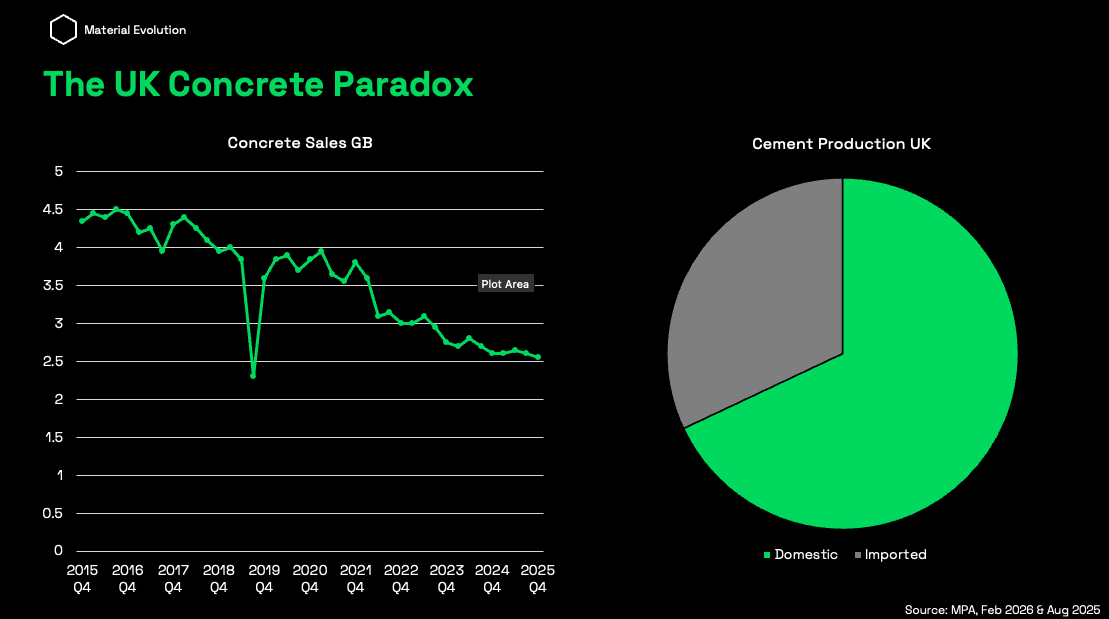
At the same time, the industry faces rising energy costs, constrained investment environments, continued pressure to reduce project costs, and growing economic uncertainty.
Across the sector, companies are tightening budgets, delaying investment decisions, and preparing for a more difficult market environment. In periods of slowdown or looming recession, risk tolerance naturally contracts. In the case of concrete, we are seeing concrete users less willing to do anything that fits outside the existing standards or business as usual.
That creates a difficult dynamic for innovation. But it also creates an opportunity. Because in tougher markets, competitive advantage matters more than ever.
As public and private sector clients face growing pressure around embodied carbon, reporting requirements, and ESG targets, the ability to offer in-code, commercially viable low-carbon solutions may become one of the industry’s strongest competitive advantages during a downturn. Further, these forward-looking companies will be best placed to take market share as the codes and standards evolve to allow more innovative products – like our cement-free MevoCem solution.
Why standards and specifications matter so much
The challenge with standards is that they are slow-moving and (rightly) require massive amounts of proof before they evolve. So there’s a catch-22: in order for cement-free binders to be declared within code, we need enough data to show they perform just as well at scale. But in order for them to be used at scale, they need to be within code.
So what’s the solve?
Low-carbon public procurement is one potential solution. (See my article on this topic here.) Public infrastructure projects, in particular, have enormous potential to accelerate market adoption – while also boosting UK competitiveness (as found in a recent Aldersgate Group report here).
When governments and major clients provide clear demand signals for lower-carbon materials, the market responds. We are already seeing examples internationally.
Countries including Denmark, France, and Ireland are introducing embodied-carbon requirements and procurement frameworks that encourage adoption of lower-carbon construction materials.
Those policies work because they create clarity. They reduce uncertainty for manufacturers, contractors, insurers, and investors. And critically, they give industry confidence to invest in domestic production capacity.
Let’s move from discussion to deployment
The industry clearly understands the challenge. Now the focus needs to shift toward implementation.
At Material Evolution, we are working with partners across the construction ecosystem to deliver low-carbon cement solutions that are both in-code and commercially viable today.
Our technology can reduce embodied carbon by up to 85% while supporting the performance, reliability, and scalability the industry requires.
If you are working on projects exploring lower-carbon construction materials, public procurement innovation, or cost-neutral decarbonisation strategies, we’d welcome the conversation.
Because the faster we align standards, procurement, and delivery around solutions that already exist, the faster we can scale meaningful emissions reduction across the built environment.