NEWS
What the Low Carbon Concrete Benchmark Means for Your Building Projects

(Editor’s note: an earlier version of this article referenced the LCCG 2025 benchmark. It has been updated to reflect the 2026 benchmark, which was released September 2026.)
If you’ve noticed more mentions of embodied carbon in project briefs recently, you’re not imagining it. Across the UK construction industry, the way we think about, measure, and specify concrete is changing – and a document called the Low Carbon Concrete Group (LCCG) Market Benchmark is at the centre of it.
In this post, we explain what the benchmark is, why it matters for anyone procuring or specifying concrete today, and how it connects to the wider commitments that are reshaping demand across the supply chain.
The LCCG Market Benchmark
What is the LCCG Market Benchmark?
The Low Carbon Concrete Group (LCCG) was established by the Green Construction Board in 2020, bringing together engineers, contractors, designers, and concrete producers with the shared aim of driving down the embodied carbon of UK concrete.
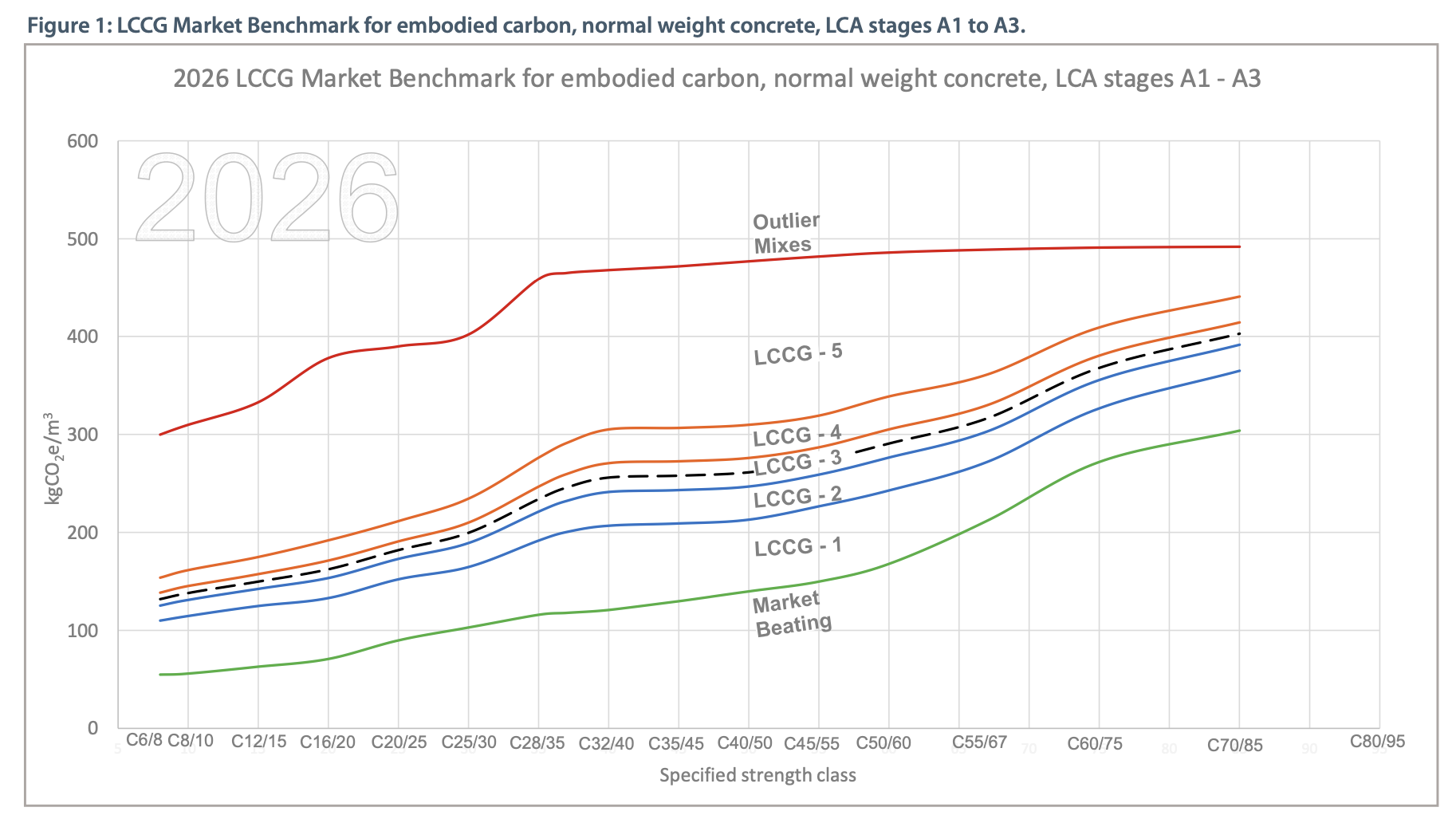
One of the LCCG’s central contributions is the LCCG Market Benchmark – a tool that quantifies and rates the embodied carbon of concrete based on real UK production data. Unlike fixed theoretical targets, this is a dynamic benchmark: it is updated annually to reflect how the market is actually performing, giving specifiers and clients a meaningful baseline against which to compare concrete mixes on their projects.
The 2026 LCCG Market Benchmark – published by the Concrete Centre at the MPA – is based on data covering approximately 55% of ready-mixed concrete produced in the UK in 2025, supplemented by data from ConcreteZero members and independent suppliers. It measures cradle-to-gate carbon emissions (LCA stages A1 to A3), expressed in kgCO₂e per m³ of concrete, categorised by strength class.
You can access the benchmark here: LCCG Market Benchmark – The Concrete Centre
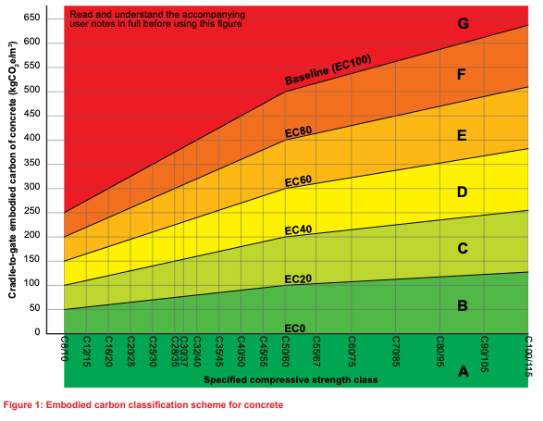
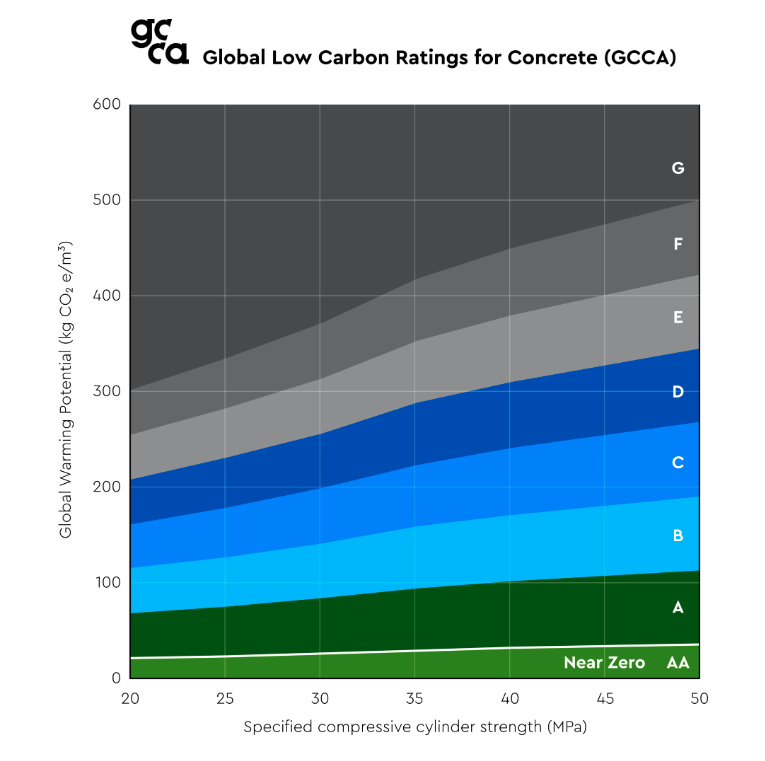
While there are other categorisation frameworks, including the GCCA Global Banding System and the Universal EC classification system championed by Arup (pictured below), the LCCG Market Benchmark is widely used in the UK.
The UK Low Carbon Concrete Group has built a classification methodology that combines all three of the above frameworks (LCCG, Arup and GCCA), called the Embodied Carbon Classification Methodology.
Why Does This Matter Now?
For most of the past decade, embodied carbon was something that progressive clients asked about on a handful of flagship projects. That is no longer the case.
Three forces are converging to make low-carbon concrete a commercial requirement rather than a nice-to-have:
1. Client and contractor commitments
ConcreteZero, the global initiative led by the Climate Group in partnership with World Green Building Council, has brought together over 38 organisations that procure or specify concrete, such as architects, designers, structural engineers, public procurement entities, etc.
Members – including major UK contractors such as Laing O’Rourke, Skanska UK, and Wilmott Dixon – have committed to 30% of their concrete use being low-emission concrete by 2025 and 50% of their concrete use being low-emission concrete by 2030, with a pathway to using 100% net zero concrete by 2050.
Their definition of low-emission concrete? Anything below the top of Band 2 on the 2024 LCCG Market Benchmark. See more detail on their classification framework – including how it corresponds to other frameworks – here.
These are not aspirational targets in the distant future. The 2025 milestone has already arrived. Contractors with ConcreteZero obligations are actively asking their supply chains what they can deliver – and making procurement decisions accordingly.
2. Procurement frameworks and EPD requirements
Environmental Product Declarations (EPDs) – independently verified, product-level carbon data – are increasingly required on project submissions and tender documents. The LCCG benchmark provides the rating scale against which EPD data is measured, effectively becoming the shared language of concrete carbon performance across the UK industry.
The Arup Universal Classification and the GCCA Global Ratings for Concrete (pictured below) work alongside the LCCG benchmark to give specifiers a consistent framework for comparing products and setting procurement thresholds. The UK Government has also referenced this framework in its policy consultation on growing the market for low carbon industrial products.
Arup Universal Classification for Concrete
GCCA Global Ratings for Concrete
3. Regulatory direction of travel
While mandatory embodied carbon limits for concrete are not yet in force across all project types in the UK, the direction of travel is clear. The UK Concrete and Cement Industry Roadmap to Beyond Net Zero, updated in 2025, sets out a trajectory that will require progressively lower carbon performance from concrete producers over the coming years.
Specifiers who wait for regulation to force the issue risk being behind the curve – particularly on public sector and infrastructure projects, where carbon reporting is already further advanced.
What Does the Benchmark Actually Require?
The LCCG benchmark rates concrete on a scale from A to E, with lower letters representing lower embodied carbon relative to the market average for a given strength class. The ratings reflect what is commercially available in the UK market, not a theoretical ideal.

A concrete scoring 15% or more below the market mean for its strength class is broadly considered ‘low carbon’ under the benchmark framework. Achieving this typically requires high levels of cement replacement using supplementary cementitious materials (SCMs) such as ground granulated blast-furnace slag (GGBS), pulverised fuel ash (PFA), or limestone powder filler.
In practice, for a specifier, this means:
- Requesting EPDs from concrete suppliers so that carbon data is available
- Using the LCCG benchmark to evaluate whether a mix is genuinely lower carbon, or simply marketed as such
- Including embodied carbon thresholds in tender requirements, referenced against the LCCG rating bands
- Tracking performance over time as part of whole-life carbon assessments
The Challenge with High-SCM Mixes
Increasing SCM content is the most accessible route to lower embodied carbon in concrete – but it comes with a well-known challenge. High levels of GGBS, PFA, or other low-carbon SCMs slow early-age strength development, which can affect demoulding times in precast production and programme in ready-mix applications.
This is one reason why the benchmark, on its own, is not enough. To genuinely achieve lower-carbon concrete at scale without compromising performance or programme, the industry needs materials and admixtures that make high-SCM mixes perform like conventional ones.
This is the problem that MevoXL, our concrete admixture, was developed to solve: enabling up to 95% OPC replacement with GGBS, PFA, or other low-carbon SCMs, while maintaining early strength development and the performance that producers and contractors depend on.
What This Means for Specifiers
Whether you are an architect, structural engineer, or sustainability lead, the LCCG benchmark gives you something concrete (pardon the pun) to work with. Rather than asking suppliers for vague commitments to ‘low carbon’ concrete, you can now specify to a benchmark, request EPDs, and make like-for-like comparisons.
A practical starting point:
- Reference the LCCG benchmark in your project specifications and ask suppliers to demonstrate where their concrete sits within it
- Require EPDs for all concrete elements above a certain volume threshold
- Engage your concrete supplier early – producers who have already trialled low-carbon mixes will be better placed to support your programme requirements
- Consider both ready-mix and precast solutions: the LCCG benchmark covers both, and switching to low-carbon precast elements can offer significant whole-project carbon savings
What This Means for Concrete Manufacturers
For concrete manufacturers, understanding the LCCG benchmark empowers you to respond proactively to your customers’ needs. It gives clarity on what specifiers are looking for, provides a snapshot of where the market is today, and indicates where things are moving.
For practical next steps:
- Calculate the embodied carbon of your mix designs and see where they fall compared to the market – you can find a tool to map your mix against the benchmark here
- Engage with your cement and aggregate suppliers to explore and trial low-carbon alternatives – learn more about Material Evolution’s low-carbon cement products here, or get in touch to learn more
See how Material Evolution is helping construction projects reduce embodied carbon. Learn more about our products here.

Further Reading
LCCG Market Benchmark 2025 – MPA The Concrete Centre: www.concretecentre.com/marketbenchmark
ConcreteZero member commitments – Climate Group: www.theclimategroup.org/concretezero
Embodied Carbon Classification Methodology – ConcreteZero / LCCG, July 2024: www.lccg.uk/home/current-activities/embodied-carbon-classification-methodology
BSI Flex 350 v2.0:2024 – Alternative binder systems for lower carbon concrete: www.concretecentre.com/Structural-design/Standards/BSI-Flex-350.aspx
Sources
[1] MPA The Concrete Centre on behalf of the LCCG. ‘Embodied carbon of concrete: Market Benchmark.’ 2026 update. www.concretecentre.com/marketbenchmark
[2] Low Carbon Concrete Group. ‘LCCG Market Benchmark 2026.’ www.lccg.uk/home/current-activities/lccg-market-benchmark
[3] Climate Group. ‘ConcreteZero — creating a market for net zero concrete.’ www.theclimategroup.org/concretezero
[4] Infrastructure Intelligence. ‘Leading firms pledge to use 100% net zero concrete by 2050.’ July 2022.
[5] ConcreteZero / LCCG. ‘Classification Methodology for Embodied Carbon of Concrete.’ July 2024. www.lccg.uk
[6] UK Government. ‘A policy framework to grow the market for low carbon industrial products: technical annex.’ June 2025. assets.publishing.service.gov.uk
[7] BSI / ICE. ‘BSI Flex 350 v2.0:2024-09 — Alternative Binder Systems for Lower Carbon Concrete. Code of Practice.’ September 2024. www.concretecentre.com/Structural-design/Standards/BSI-Flex-350.aspx
[8] MPA / Concrete Centre. ‘UK Concrete and Cement Industry Roadmap to Beyond Net Zero: Progress Report 2025.’ September 2025.